

More Than Test Scores. Real Development Insights.
Your Athletic Future Starts Here

Learn what's included in the NPI Presidential Score Report, why it matters, and how athletes, parents, and coaches use it to support long-term athletic development.
The NPI Presidential Score Report transforms athletic testing into a personalized roadmap for development, helping athletes, parents, and coaches understand where an athlete stands today and where they can go next.
✓ Understand current athletic readiness
✓ Compare performance against age- and sex-specific benchmarks
✓ Identify athletic strengths and development opportunities
✓ Discover potential sport and position tendencies
✓ Track measurable progress through retesting
✓ See if you're on track for future collegiate athletic potential
Used by Athletes, Parents, and Coaches to Measure Progress, Identify Opportunities, and Track Long-Term Development.
More Than Test Scores. Real Development Insights.
Your Athletic Future Starts Here
The NPI Presidential Score Report transforms athletic testing into a personalized roadmap for development, helping athletes, parents, and coaches understand where an athlete stands today and where they can go next.
✓ Understand current athletic readiness
✓ Compare performance against age- and sex-specific benchmarks
✓ Identify athletic strengths and development opportunities
✓ Discover potential sport and position tendencies
✓ Track measurable progress through retesting
✓ See if you're on track for future collegiate athletic potential
Used by Athletes, Parents, and Coaches to Measure Progress, Identify Opportunities, and Track Long-Term Development.
HOW TO READ AND UNDERSTAND
THE NPI PRESIDENTIAL ATHLETIC REPORT
WHAT IS THIS REPORT?
The NPI Presidential Score Report provides a complete snapshot of athletic performance based on standardized athletic testing.
Rather than looking at individual test scores alone, the report combines multiple performance indicators into a single development framework that helps athletes understand where they stand today and what to improve next.
STANDARDIZED TESTING
Built on proven, standardized athletic assessments used nationwide.
MEANINGFUL INSIGHTS
Turns raw data into clear insights you can act on.
A ROADMAP FOR GROWTH
Helps athletes, parents, and coaches make smarter decisions.
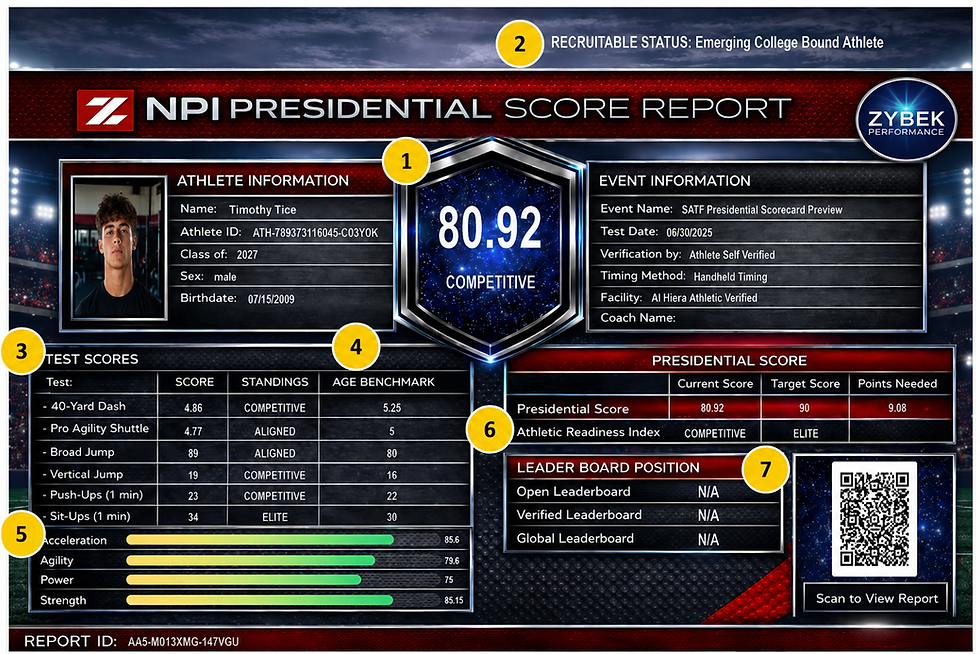
How to read each section and why it matters.
-
Presidential Score – A single score that summarizes overall athletic development and readiness.
-
Recruitable Status – Indicates whether an athlete is currently performing at an age-appropriate level associated with future collegiate athletic potential.
-
Test Scores – Raw scores from each assessment that form the foundation of the report.
-
Age-Based Benchmarks – Compare scores to athletes of the same age and stage.
-
Performance Summary – Breaks performance into key categories to highlight strengths and opportunities.
-
Athletic Readiness Index – Shows how an athlete aligns with age-based development expectations.
-
Leaderboard Position – Shows where the athlete ranks locally, nationally, and globally (where available).
What It Means
The Presidential Score is the primary score of the NPI Presidential Score Report. It combines multiple athletic performance indicators into a single score that summarizes overall athletic development and readiness.
The score is calculated using age-specific and sex-specific performance benchmarks, helping ensure athletes are evaluated relative to others at a similar stage of physical development.
Why It Matters
Athletic performance is made up of many different skills and abilities. The Presidential Score provides a simplified way to understand overall performance without needing to analyze every individual test result separately.
Because the score is age-specific and sex-specific, it provides a more meaningful comparison than raw athletic results alone. This allows athletes, parents, and coaches to better understand current performance within the context of expected development for the athlete's age and sex.
The score also serves as a benchmark that athletes, parents, and coaches can use to measure progress over time.
How To Use The Score
The Presidential Score should not be viewed as a pass-or-fail measurement. Instead, it should be viewed as a snapshot of current athletic development and a starting point for future growth.
As athletes mature, train, and retest, their Presidential Score may increase, providing an objective way to track long-term athletic development.
Example
An 80-point Presidential Score may represent very different levels of performance for athletes of different ages. Because the score is age-specific and sex-specific, the focus should not be on comparing scores across different age groups, but rather on understanding how an athlete is performing relative to peers of the same age and sex.
Key Takeaway
The Presidential Score provides an age-specific and sex-specific snapshot of overall athletic development and serves as a benchmark for tracking improvement over time.
What It Means
Recruitable Status is only available for athletes ages 14 and older. It is a special designation that appears only when an athlete has achieved the performance standards required to qualify.
The designation indicates that an athlete is currently developing at a level that aligns with age-based expectations associated with future college athletic opportunities.
Why It Matters
Recruitable Status is based on the athlete's overall Athletic Readiness Index (ARI) and performance profile relative to athletes of the same age and stage of development.
Not all athletes age 14 and older will receive a Recruitable Status designation. The status only appears when an athlete meets the minimum qualification requirements, including achieving at least an ARI-Aligned level of athletic readiness.
A Recruitable Status designation does not mean an athlete has already achieved college-level athletic performance or has been recruited by a college program.
Instead, it indicates the athlete has demonstrated performance levels that suggest they are progressing along a developmental pathway associated with future collegiate athletic potential.
Eligibility Requirements
To receive a Recruitable Status designation, an athlete must:
-
Be 14 years of age or older
-
Meet the required Athletic Readiness Index (ARI) qualification standards
-
Demonstrate performance levels consistent with the Recruitable Status criteria
-
If these requirements are not met, the Recruitable Status field will not appear on the athlete's report.
How To Use Recruitable Status
Recruitable Status should be viewed as a developmental milestone rather than a final destination.
Athletes who earn the designation can use it as an indicator that their current development is trending toward future collegiate athletic potential.
For athletes who have not yet earned Recruitable Status, it can serve as a measurable goal to work toward through continued training, development, and retesting.
Coaches can use Recruitable Status to help identify athletes who may be progressing toward higher levels of athletic readiness and to support development planning.
Parents can use Recruitable Status as a benchmark to better understand their athlete's long-term development while recognizing that continued growth, training, and sport-specific skill development remain important.
Key Takeaway
Recruitable Status is an earned developmental designation, not a recruiting guarantee. Available only to qualifying athletes ages 14 and older, it helps athletes, parents, and coaches understand whether current performance trends are aligned with future collegiate athletic potential while providing a measurable milestone for continued development.
-
What It Means
Test Scores display the athlete's raw results from each athletic assessment completed during testing.
Why It Matters
These scores are the foundation of the report and provide the objective measurements used to calculate performance classifications, benchmarks, and overall readiness indicators.
More importantly, this section helps athletes, parents, and coaches identify athletic strengths and development opportunities. By comparing results across multiple tests, it becomes easier to determine which performance areas are excelling and which areas may require additional training and attention.
This information can be used to build more effective training plans, establish measurable goals, and track improvement over time.
Test Score Standings
-
Foundational: The athlete is building the basic athletic foundation needed for long-term development. This level identifies important opportunities to improve core movement skills, strength, speed, power, and overall readiness.
-
Developing: The athlete is showing progress but is still working toward age-based development expectations. This level indicates improvement is happening, but additional training and consistency are needed to reach the next stage.
-
Aligned: The athlete is performing at a level that aligns with age-based expectations. This means the athlete is currently on track for their age and stage of development.
-
Competitive: The athlete is performing above age-based expectations and showing strong athletic readiness compared to peers. This level indicates the athlete is developing at a competitive level for their age.
-
Elite: The athlete is performing at an advanced level relative to age-based expectations. This level reflects exceptional athletic readiness and a high-performance profile compared to same-age athletes.
How To Use Test Scores
Test Scores should be used as a tool for identifying athletic strengths, development opportunities, and future training priorities.
Athletes can use these scores to understand which performance areas are improving and which areas may require additional focus.
Coaches can use Test Scores to build more targeted training plans and track measurable progress over time.
Parents can use Test Scores to better understand their athlete's development while helping set realistic goals for future improvement.
By comparing scores across multiple tests and testing periods, athletes, parents, and coaches can make more informed decisions about training, development, and long-term athletic growth.
Key Takeaway
Test Scores provide the measurable performance data that drives the entire report while helping athletes, parents, and coaches identify strengths, weaknesses, and areas for future development.
-
What It Means
Age-Based Benchmarks compare an athlete's performance to other athletes of the same age, sex, and stage of development.
These benchmarks provide the reference points used to evaluate athletic performance within an appropriate developmental context.
Why It Matters
Performance should always be evaluated within the context of age, sex, and development. Benchmarks help determine whether an athlete is performing below, near, or above expected standards relative to similar athletes.
Without benchmarks, raw scores alone can be difficult to interpret. A score that is exceptional for one age group may be average for another. By comparing performance to athletes of the same age and sex, the report provides a more meaningful and accurate assessment of athletic development.
How To Use The Benchmarks
Benchmarks help athletes, parents, and coaches understand where current performance stands today while identifying areas that may require additional focus and development.
They also provide a valuable reference point for measuring progress through future testing and retesting.
Key Takeaway
Age-Based Benchmarks provide age-specific and sex-specific context that helps athletes understand how their performance compares to peers at a similar stage of development.
What It Means
The Performance Summary organizes athletic performance into key development categories such as Acceleration, Agility, Power, and Strength.
These categories provide a high-level view of how an athlete performs across the major athletic traits that contribute to sports performance.
Why It Matters
Most athletes have areas where they excel and areas where additional development is needed. The Performance Summary helps identify both strengths and opportunities for improvement.
By viewing performance across multiple categories, athletes, parents, and coaches can make more informed training decisions and focus on the areas that will have the greatest impact on future development.
The Performance Summary can also provide insight into the types of athletic activities, sports, or positions where an athlete's natural strengths may be most valuable. While no single score determines athletic success, understanding an athlete's performance profile can help guide development and sport-specific decision-making.
Examples
An athlete who demonstrates exceptional Acceleration and Agility may naturally excel in sports and positions that require quick reactions, rapid changes of direction, and the ability to create separation from opponents. For example, a soccer winger often relies heavily on acceleration and agility to create scoring opportunities.
An athlete with strong Power scores may show greater potential in activities that emphasize explosiveness, jumping ability, and force production. For example, a volleyball outside hitter often benefits from exceptional power and jumping ability.
An athlete with high Strength scores may be well suited for sports and positions that require physical presence, stability, and the ability to generate force against resistance. For example, a football offensive lineman often relies on strength to perform at a high level.
Athletes who perform well across all categories often demonstrate a versatile athletic profile that can transfer successfully across multiple sports and competitive environments. For example, a soccer midfielder frequently benefits from a balanced combination of acceleration, agility, power, and strength.
These insights should not be viewed as limitations, but rather as tools that help athletes, parents, and coaches better understand natural strengths while identifying areas that can continue to be developed.
How To Use The Performance Summary
The Performance Summary should be used as a guide for understanding an athlete's unique athletic profile.
Athletes can use this section to identify their strongest performance areas while recognizing which traits may need additional development.
Coaches can use the Performance Summary to help prioritize training, build more individualized development plans, and identify athletic traits that may support specific sports or positions.
Parents can use the Performance Summary to better understand how their athlete's natural strengths and development opportunities may influence future athletic growth and sport participation.
When reviewed over time through retesting, the Performance Summary can also help measure how an athlete's performance profile is evolving as they mature, train, and develop.
Key Takeaway
The Performance Summary helps identify athletic strengths, development opportunities, training priorities, and potential sport-specific tendencies based on an athlete's unique performance profile.
What It Means
The Athletic Readiness Index (ARI) evaluates how an athlete's current performance aligns with age-based athletic development expectations.
Rather than focusing on a single test score, the ARI looks at the athlete's overall performance profile to help determine where they currently fall on the developmental pathway for their age.
Why It Matters
Athletes develop at different rates. The ARI helps athletes, parents, and coaches understand whether current performance is below, approaching, meeting, or exceeding age-based expectations.
ARI Levels
-
Foundational: The athlete is building the basic athletic foundation needed for long-term development. This level identifies important opportunities to improve core movement skills, strength, speed, power, and overall readiness.
-
Developing: The athlete is showing progress but is still working toward age-based development expectations. This level indicates improvement is happening, but additional training and consistency are needed to reach the next stage.
-
Aligned: The athlete is performing at a level that aligns with age-based expectations. This means the athlete is currently on track for their age and stage of development.
-
Competitive: The athlete is performing above age-based expectations and showing strong athletic readiness compared to peers. This level indicates the athlete is developing at a competitive level for their age.
-
Elite: The athlete is performing at an advanced level relative to age-based expectations. This level reflects exceptional athletic readiness and a high-performance profile compared to same-age athletes.
Understanding Your ARI Progress
The Athletic Readiness Index section not only shows an athlete's current readiness classification but also provides a roadmap toward the next level of achievement.
Current Score
Represents the athlete's current Presidential Score based on their testing results.
Target Score
Represents the minimum Presidential Score required to reach the next Athletic Readiness Index level.
Points Needed
Shows the difference between the athlete's Current Score and the Target Score. This number represents how many additional points are needed to advance to the next readiness classification.
Example
If an athlete has:
-
Current Score: 80.92
-
Current ARI Level: Competitive
-
Target Score: 90.00
-
Target ARI Level: Elite
-
Points Needed: 9.08
This means the athlete currently falls within the Competitive classification and must improve their Presidential Score by 9.08 points to achieve the Elite level.
How To Use The Athletic Readiness Index
The Athletic Readiness Index should be used as a tool for measuring current athletic development and tracking future progress.
Athletes can use their ARI level, Current Score, Target Score, and Points Needed to set measurable goals and understand what is required to reach the next level of readiness.
Coaches can use the ARI to monitor athlete development, establish training priorities, and track improvement over time through retesting.
Parents can use the ARI to better understand where their athlete currently stands relative to age-based expectations while tracking long-term development progress.
As athletes mature, train, and retest, the ARI provides a clear roadmap for growth by showing both current performance and the next level of achievement to work toward.
Key Takeaway
The ARI is a developmental indicator, not a final label. Athletes can move between levels over time as they mature, train, retest, and improve.
-
What It Means
Leaderboard Position shows where an athlete ranks relative to other athletes within available NPI testing databases.
Why It Matters
Rankings provide additional context and help athletes understand how their performance compares locally, nationally, and globally when sufficient comparison data is available.
Leaderboard rankings are intended to provide perspective and motivation while encouraging continued development and improvement.
How To Use Leaderboard Position
Leaderboard Position should be used as a source of perspective and motivation, not as the sole measure of athletic success.
Athletes can use leaderboard rankings to understand how their performance compares to other tested athletes while setting goals for future improvement.
Coaches and parents can use leaderboard data as an additional reference point when evaluating development and tracking progress over time.
Because rankings can change as more athletes are tested and as athletes continue to improve, leaderboard positions should be viewed as a snapshot of current performance rather than a permanent standing.
Key Takeaway
Leaderboard Position provides comparative ranking information that helps athletes understand where they currently stand relative to other tested athletes.
DESIGNED FOR PARENTS
✓ Objective measurement of your athlete
✓ Clear development roadmap
✓ Track progress year after year
✓ Understand strengths and weaknesses
✓ Make informed training decisions
BUILT FOR COACHES
✓ Establish measurable baselines
✓ Monitor athlete development
✓ Identify training priorities
✓ Track improvement over time
✓ Create objective athlete conversations
ONE TEST CREATES A BASELINE.
RETESTING CREATES DEVELOPMENT.
The most valuable insight is not a single score.
The real value comes from measuring improvement over time.
Retesting allows athletes, parents, and coaches to:
✓ Verify training effectiveness
✓ Measure development
✓ Identify plateaus
✓ Adjust training plans
✓ Build long-term progress